It's 5-5 in the deciding set of an AITA under-16 final.
Two players stand at either end of the court. Both have spent years in academies. Both can serve over 160 km/h. Both have coaches who believe in them, parents who have driven them across cities for tournaments, and training logs that stretch back to childhood.
The one who wins this match isn't the one with the cleaner forehand. It's the one who can breathe.
The Moment Technique Stops Mattering
Most conversations in junior tennis revolve around the physical game. How's the second serve? Has the backhand improved? Is the footwork sharp enough? These are fair questions. Technical development matters enormously in the early years of a player's journey. But there comes a point in every competitive career — often earlier than coaches and parents expect — where technique is no longer the differentiating factor.
Walk the courts at any AITA national tournament and you'll witness something quietly remarkable. The players, by and large, look very similar. The strokes are solid. The movement is trained. The fitness is decent. Years of drilling have produced a field of juniors who, on paper, are technically comparable.
And yet, by the end of the day, the scorelines tell wildly different stories.
Some players who looked dominant in the warm-up crumble in the third set. Others who appeared tentative early find a gear under pressure and close out matches they had no business winning. The pattern repeats across age groups, across cities, across seasons.
The explanation isn't found in technique alone. It's also found in what's happening between the ears — and that dimension of performance rarely receives the same systematic attention as the physical one.
The Gap Nobody Is Training
Ask a junior player how many hours a week they spend on groundstrokes. You'll get a specific answer. Ask them how many hours they spend deliberately training their mental game. You'll mostly get silence.
This is the defining gap in junior tennis development in India — and, frankly, across the world.
Physical training has structure. There are drills, benchmarks, coaches who can observe and correct in real time. Technical weaknesses are visible. A flat-footed approach shot can be caught on video. A mis-timed serve shows up immediately in double fault counts.
Mental performance is different. It lives beneath the surface. You can't see confidence leave a player's body the way you can see a mishit. You can't observe the exact moment a player stops believing they can win a set they're leading 4-2. You can't measure, with the naked eye, how long it takes someone to emotionally reset after a bad line call.
And because you can't see it clearly, it often doesn't get trained at all.
The result is predictable. Players who are technically gifted lose repeatedly in close matches and don't know why. Coaches who are excellent at teaching strokes run out of answers when the problem isn't a stroke. Parents watch their child underperform in tournaments and assume it must be physical — fitness, perhaps, or nerves that will simply sort themselves out with age.
They rarely sort themselves out with age. Untrained habits don't improve on their own.
What Actually Happens at 30-40
To understand why mental training matters, it helps to understand what pressure actually does to a tennis player's body and mind.
Under stress, the nervous system activates. Heart rate climbs. Muscle tension increases. Cognitive resources that normally support decision-making, tactical thinking, and emotional regulation become taxed — and the automated, well-practised skills that feel effortless in training can suddenly feel effortful and unreliable. Attention narrows. Processing speed drops. The mental bandwidth available for clear shot selection and tactical adjustment shrinks precisely when it's needed most.
For a tennis player, this shows up in specific, recognisable ways.
The serve that felt fluid in the warm-up suddenly feels mechanical. The player grips the racket tighter. Backswings shorten. Ball toss location drifts. The smooth, practised motion that produced reliable first serves all week produces a double fault on break point.
Or the player who attacked confidently through the first set becomes passive. Instead of going for winners, they push the ball back and hope for errors. Instead of moving forward, they stay on the baseline. Instead of playing their game, they start playing not to lose — which is an entirely different and far less effective game.
These aren't signs of a bad player. They're signs of an undertrained mental response to pressure. Individual differences in how players experience and respond to stress are real — some players are naturally more anxiety-prone or reactive than others. But the research on mental skills training is clear: these responses are significantly improvable with the right, targeted work. The starting point is understanding exactly what's going wrong.
Eleven Dimensions of Mental Performance
At Tennis.University, the approach to mental performance is grounded in the belief that vague language produces vague results. Telling a player to "be stronger mentally" is the coaching equivalent of telling them to "hit better shots." It's true, technically. It helps no one.
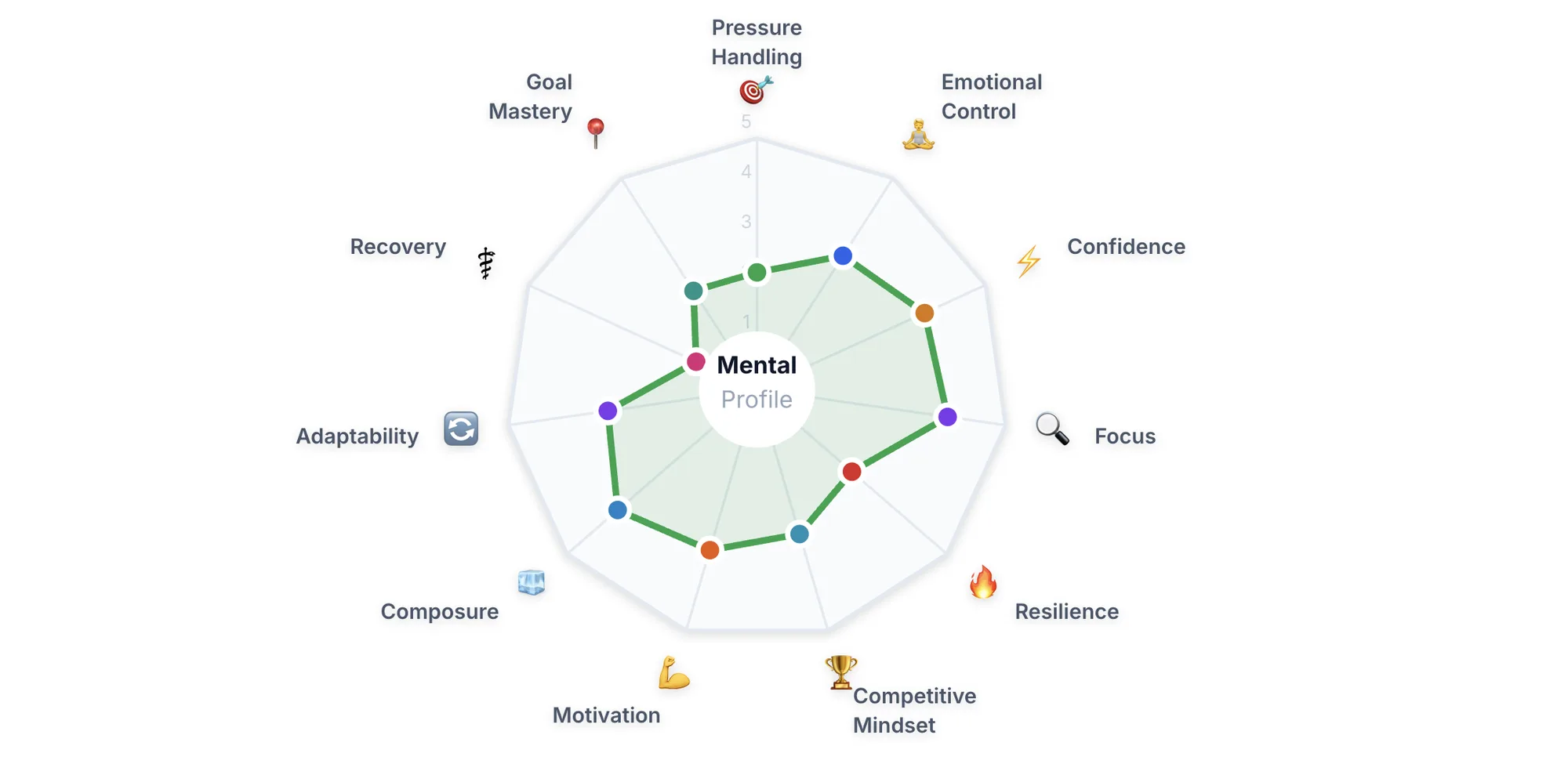
Instead, mental performance can be broken into specific, observable dimensions — eleven of them — each of which influences competitive outcomes in distinct ways. Some of these dimensions relate closely to constructs well-established in the sports psychology literature: self-efficacy, attentional control, emotional regulation, and approach-avoidance motivation, among others. The eleven-dimension framework used here organises these concepts in terms that are practical and directly applicable to junior tennis, rather than strictly theoretical. Some dimensions overlap by design — they describe related but meaningfully distinct aspects of mental performance that require different interventions.
Focus is the ability to stay locked on the next point rather than the scoreboard, the crowd, or the last mistake. Players with strong focus don't let the context of a match bleed into their execution of individual points. Players with weak focus drift — toward the scoreline, toward what a loss would mean, toward what their coach is thinking on the sideline.
Confidence is more complex than it appears. Surface confidence — the kind that exists when things are going well — is almost universal. Deep confidence, the kind that survives a poor first set or a string of unforced errors, is rare. The critical question is what a player's confidence is built on. If it's built on the feel of the warm-up, it's fragile. If it's built on the knowledge of preparation, it's durable.
Composure refers to the ability to maintain routines and decision-making clarity during high-pressure moments. Composed players look the same at 5-5 as they do at 3-0. Their between-point rituals are consistent. Their body language doesn't telegraph the scoreline. Composure is both a mental skill and a physical one — it's expressed through posture, breathing, and routine.
Pressure Handling is a distinct dimension that specifically concerns break points, set points, and match points. Some players genuinely perform better under pressure — they find sharper focus when the stakes rise. Others perform significantly worse. Neither is a fixed trait. Both are trainable, but only if identified.
Emotional Control measures the speed and quality of recovery from adversity during a match. A bad call. A shanked forehand on a crucial point. A double fault at the worst possible moment. How long does a player carry that moment? Players with strong emotional control reset quickly and move on. Players with weak emotional control let one moment contaminate the next five points.
Competitive Mindset describes whether a player attacks or retreats when the match tightens. This is the aggression question — not the technical kind, but the psychological kind. Does pressure cause a player to compete harder or to protect their ego by playing conservatively?
Adaptability measures the tactical intelligence to recognise when a game plan isn't working and change it without panicking. Rigid players play the same way regardless of results. Adaptable players read the match, adjust, and find new solutions.
Resilience is the capacity to maintain belief when the scoreline is against you. A player down 2-5 in the third set has a choice: compete for every point remaining or mentally concede the match while going through the physical motions. Resilience determines which choice gets made.
Recovery is specifically about the transition between sets. Losing a set is a micro-crisis. How a player responds to that crisis — whether they carry it into the next set or genuinely reset — significantly influences the match outcome. Poor recovery turns a one-set loss into a two-set loss. Good recovery turns a lost set into a new match.
Motivation concerns the ability to maintain training intensity over time — not just before a big tournament, but through the routine months that make up most of a player's year. Players with strong motivation train the same way in February as they do the week before a national championship. Players with weak motivation train in bursts.
Goal Mastery measures whether a player's stated goals actually influence their in-match decisions and their daily training. Many players can articulate ambitious goals. Far fewer have genuinely internalised those goals to the point where they direct behaviour under pressure, when nobody is watching, at the difficult moments of a tough match.
Each dimension is distinct. Each is trainable. And critically, each requires specific interventions — not generic advice.
The Problem With Opinions
For most of tennis history, mental performance has been assessed through impressions. A coach observes a player losing composure and forms a view. A parent notices that their child plays better in practice than tournaments and assumes it's nerves. The player themselves feels the anxiety but can't locate where it comes from or why it gets worse in certain situations.
Impressions are useful starting points. But they're subjective, inconsistent, and difficult to act on precisely.
"You need to believe in yourself more" is an instruction that a player cannot execute on the court. There is no drill for it. There is no feedback mechanism. The advice evaporates in the heat of competition.
What changes outcomes is precision. Not "be more resilient" but "you have a specific pattern where you mentally concede sets when the score reaches 3-5, regardless of how competitive the points themselves have been — here's a structured approach to interrupt that pattern." That's a direction a player can act on. That's something a coach can build into training.
The Tennis.University Mind Map is designed to provide exactly this kind of precision. By assessing all eleven dimensions systematically, it produces not just a profile but a ranked set of priorities — the areas where improvement will have the most significant impact on competitive results, and specific training approaches linked directly to each area.
What Coaches Can Do With Real Data
One of the most underappreciated challenges in coaching junior tennis players is the gap between practice performance and match performance. Coaches see their players daily. They know what they're capable of. They watch them execute shots in training that disappear in competition. They've had the conversations. They've given the encouragement. And it hasn't changed the pattern.
The frustration is genuine, and it's rooted in a real limitation: without data on the specific mental dimensions at play, coaches are treating symptoms rather than causes.
A player who surrenders leads might have a Composure problem, a Confidence problem, a Competitive Mindset problem, or a Pressure Handling problem — or some combination. Each requires a different response. Grouping them all under "mentally weak" obscures the distinction and makes effective intervention impossible.
When coaches have access to a detailed mental profile, they can match their interventions to the actual problem. A player with strong Resilience but poor Emotional Control doesn't need motivational speeches — they need structured techniques for rapid emotional reset between points. A player with strong Confidence but weak Adaptability doesn't need encouragement — they need tactical problem-solving training under simulated match pressure.
The precision changes not just what coaches do, but how they communicate with their players. "This month we're working on your recovery between sets" is a specific, actionable, measurable goal. It gives both coach and player a shared language for something that was previously described only in frustration.
What Parents Can See When They Know What to Look For
Parents occupy a difficult position in junior tennis. They invest significantly in their child's development — financially, emotionally, logistically. They attend matches. They observe performance. They want to help.
But they're often watching through the wrong lens.
A child who appears lazy on the court may be experiencing severe anxiety that manifests as disengagement. A player who seems to give up may have a recovery problem that no amount of encouragement from the stands will fix. A technically gifted junior who loses every close match may have excellent strokes and deeply underdeveloped pressure handling.
When parents understand the mental dimensions at play, their response changes. Instead of increased pressure after a loss — "you need to try harder" — they can offer the kind of support that actually addresses the problem. Instead of frustration at underperformance, they can understand that the gap between training and match performance is a specific, solvable problem.
This matters more than it might seem. Parental pressure is one of the most significant contributors to poor mental performance in junior athletes. Understanding the real problem is the beginning of responding to it constructively.
Why the Best Players Train Their Minds
It's worth examining what separates elite players not just technically but mentally.
The top players in the world — across generations — share certain observable mental characteristics. They have consistent pre-point routines. They manage their emotional expression carefully. They demonstrate tactical adaptability within matches. They recover from adversity visibly and quickly. They compete until the last point of a match regardless of scoreline.
None of this is accidental. These are trained behaviours.
Roger Federer's long-standing work with sports psychologist Gregor Haas is well-documented. Novak Djokovic has spoken and written at length about mindfulness and mental preparation as central to his development. Rafael Nadal's match rituals — the precise ball bounces, the water bottle placement, the between-point routine — are expressions of a structured mental system designed to maintain composure and reset focus under pressure.
It's worth being clear about what these examples do and don't tell us. Elite players who combine exceptional talent with deliberate mental training tend to dominate. What we see less clearly are the mentally disciplined players who were simply not talented enough — survivorship bias means champions are visible and their mental habits get celebrated. The point isn't that mental training guarantees success. It's that at the highest levels of competition, neglecting it almost certainly guarantees a ceiling.
Junior players in India — competing for AITA titles, working toward national rankings, dreaming of professional careers — should aspire to the same standard. Not as elite professional athletes, but as serious competitors who understand that the mental game isn't a bonus feature but a core component of competitive performance.
Measurable Progress
Perhaps the most important shift that comes from treating mental performance as a measurable discipline is what it does to the player's relationship with their own development.
Tennis is a long game. Development is uneven. Plateaus are common. The path from club-level junior to nationally competitive player involves years of incremental improvement across dozens of dimensions. It can feel invisible from the inside.
When mental performance is measured, it becomes possible to track progress. A player who scores poorly on Pressure Handling can retest months later and see genuine improvement. A player whose Emotional Control was identified as a match risk can observe, quantifiably, that their recovery times have shortened.
This is motivating in a specific, grounded way. Not "you're getting better" — a reassurance that players have learned to discount — but "here's the data showing you're getting better, in this specific area, by this measurable amount."
For young athletes learning to take ownership of their own development, that kind of concrete feedback is transformative.
The Players Who Will Win Tomorrow
The next generation of Indian tennis — the players who will carry the country's game forward at Davis Cup level, at Grand Slam qualifying level, at the professional tour level — will not be defined simply by who hit the most balls as a junior.
They'll be defined by who understood themselves as competitors.
Technique is necessary. Fitness is necessary. Tactical intelligence is necessary. But the competitive arena sorts players who have all of these things by something that cannot be observed from a baseline: mental strength under pressure, in the moments that count, when the match is alive and everything is on the line.
The players who understand this early — who start building their mental games at 14 and 15 rather than trying to repair them at 22 — will have an enormous advantage over equally talented players who treated the mind as an afterthought.
Taking the First Step
Measurement is where improvement begins.
Not because a score tells a player everything they need to know, but because a score tells them where to look. It transforms a vague sense of underperformance into a specific set of priorities. It gives coaches a language for conversations that previously ended in frustration. It gives parents insight into what's actually happening rather than what the scoreline suggests.
The Tennis.University Mind Map was built with this purpose. Eleven dimensions. A complete mental profile. A tailored action plan that connects assessment results directly to training interventions. Not a personality label, but a roadmap.
As with any self-report assessment, it works best when players engage with it honestly and when results are interpreted alongside a coach's direct behavioural observations — self-awareness in adolescents varies, and assessment tools are most powerful when they open a conversation rather than deliver a verdict.
Because the question for serious junior players isn't whether the mental game matters. At 5-5 in the deciding set, everyone knows it matters.
The question is whether you've trained for it.
Your mind is your most important racket. The best players in the world figured that out a long time ago.
Now it's your turn.
Tennis.University Mind Map
Mind Map gives you a precise, data-driven picture of how your mental game holds up — not in practice, but in the moments that decide matches.